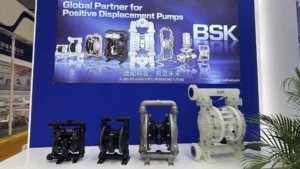

Fluid transfer is one of the least glamorous and most critical operations in pharmaceutical manufacturing. Whether a buffer solution is being charged into a bioreactor, a potent API is being moved from a dispensing vessel to a filling line, or CIP concentrate is being circulated through a pipework loop, every one of those steps carries a risk that is unacceptable in almost any other industry: contamination, molecular degradation, and cross-contamination between products.
Pneumatic diaphragm pumps (AODD pumps) have become the default solution for a large share of these applications, and for good reason. Their air-driven, positive-displacement architecture removes the rotating shafts, mechanical seals and lubricated joints that make conventional pumps a persistent contamination risk in sterile environments, while the fluid path can be built entirely from materials that do not react with the product.
This guide walks through what actually matters when specifying an AODD pump for pharmaceutical duty: how sterility is achieved, how product integrity is protected, how a single pump family covers very different fluids, and the selection details that most often get overlooked.
Why Fluid Transfer Is a Critical Process in Pharmaceutical Manufacturing
Before diving into selection criteria, it is worth placing pharmaceutical duty in context: sanitation pumps are the general clean-environment class, and a broader overview of why sanitation pumps matter in pharmaceutical manufacturing covers the compliance and hygiene case in full. This guide focuses on the narrower, more practical question: which pump specification actually holds up in a sterile process, and how to choose it.
Pharmaceutical production spans an unusually wide range of fluid characteristics. A single facility may handle water-based buffers at 1 mPa·s, a 20,000 mPa·s viscous cream, an aggressive solvent, or a particle-laden suspension carrying API crystals at 40% w/w. The transfer step sits directly between formulation and filling, so any deviation introduced here shows up in the finished batch.
Four risks recur in pharmaceutical fluid transfer:
- Contamination — biofilms in crevices, lubricant carry-over, or leachable components entering the product.
- Product degradation — shear stress damaging monoclonal antibodies or other sensitive biologics, or reactive wetted materials chemically attacking the API.
- Cross-contamination — residue from the previous product surviving into the next batch, particularly during changeover.
- Process variability — flow rates that drift with viscosity or air pressure, giving inconsistent dosing and inconsistent batch records.
An AODD pump addresses all four, but only if it is specified correctly. The pump type is the easy part; the wetted materials, surface finish, and connection geometry are where pharmaceutical projects succeed or fail.
Ensuring Sterility and Preventing Contamination
Sterile production demands absolute asepsis. Conventional pumps create harborage points: shaft seals, bearing housings, and the crevices where a rotating shaft meets a stationary casing. Even with routine CIP, these areas can retain biofilm between campaigns.
A diaphragm pump removes the wetted-end geometry almost entirely. The only moving part inside the fluid path is the diaphragm itself, which flexes rather than rotates, and the chamber behind it is dry and isolated from the product. Three design features matter most for sterile applications:
- Seal-less construction — there is no mechanical seal and therefore no lubricant that could migrate into the product.
- Smooth, drainable interiors — no low points where residue can pool and survive a cleaning cycle. This is what allows the pump body to be fully self-draining.
- Clean-in-place compatibility — 316L stainless steel wetted parts tolerate standard CIP caustic and acid regimes, and steam-in-place cycles at 121 °C where the process requires full sterilisation.
For multi-product facilities, the changeover question deserves specific attention. Options that materially reduce cross-contamination risk include quick-change diaphragm replacement, disposable diaphragm variants that are discarded after a product change, and air-driven liquid-conversion (liquid-to-liquid) pumps that can be fully depressurised and drained without opening the fluid chamber.

Protecting Product Integrity and API Purity
Biologics and high-potency APIs are unusually sensitive. In a conventional positive-displacement pump with an impeller, or in a centrifugal pump running far above its duty point, the product is subject to turbulent shear. For monoclonal antibodies and other complex molecules, that shear can aggregate the protein, reduce potency, and create subvisible particles that trigger batch rejection at the filling stage.
Diaphragm pumps displace fluid with a reciprocating chamber rather than a rotating element, so the product sees a much gentler profile. That said, the raw stroke produces a pulsed flow, and for extremely shear-sensitive products the pulsation should be damped with a pulsation dampener fitted on the discharge side. A diaphragm pump also removes the possibility of shaft-driven seal wear introducing particles into the batch.
The second half of product integrity is chemical. Wetted components must be chemically inert toward the product: PTFE and 316L stainless steel are the default pairing for most pharmaceutical duties, because neither participates in a reaction with the API. The full diaphragm material matrix — PTFE, EPDM, NBR, Viton and the PTFE-clad alternatives — is covered in our AODD pump diaphragm material selection guide, and the role of each component in the pump is explained in understanding the wet end of an AODD pump.

Handling the Full Range of Pharmaceutical Fluids
One of the strongest practical arguments for diaphragm pumps in pharmaceutical plants is that a single platform can cover fluid types that would otherwise require separate pump families.
Flow rate is governed by air pressure, so a single pump can be fine-tuned across a wide operating band simply by regulating supply pressure — useful when a buffer tank feeds a batch that later needs a viscous cream. Diaphragm pumps also handle solids-carrying fluids well: the flow path is unobstructed, and the elastomer wetted parts tolerate the passage of soft particles that would erode an impeller or jam a valve. This matters for suspensions, where particle uniformity in the delivered batch must be maintained rather than destroyed.
Because there is no rotating shaft, there is also no shaft seal to fail, and the pump can run dry without immediate damage. Combined with air-driven operation, this means the pump presents no ignition source — an advantage in solvent handling areas classified for hazardous atmospheres.
Material Selection for Pharmaceutical Applications
Choosing the wetted materials is the decision that most affects whether a pump passes validation. The short version:
| Component | Typical pharmaceutical choice | Selection note |
|---|---|---|
| Pump body / fluid chamber | 316L stainless steel, or FDA-compliant plastic (PP, PVDF, PTFE) | 316L for CIP and high-pressure service; plastics for chemical compatibility where pressure is low |
| Diaphragm | PTFE, EPDM, or PTFE-clad EPDM | PTFE for chemical resistance, EPDM for steam and hot water — PTFE-clad EPDM gives both |
| Air chamber | Aluminium, coated steel | Never in contact with product; isolated by the diaphragm |
| Seal faces / valve seats | PTFE, ceramic, or hardened stainless | Seats decide the practical pressure rating, not the body |
| Surface finish (316L parts) | Ra ≤ 0.8 µm, electropolished where required | Roughness determines how much residue a CIP cycle can actually remove |
| Connections | Tri-clamp / sanitary clamp | Allows full disassembly for cleaning and inspection between products |

Two practical warnings. First, do not select a diaphragm on chemical resistance alone — an EPDM diaphragm is excellent against caustic and hot water but will be degraded by mineral oils and many aromatic solvents, while PTFE is broadly resistant but can be cut by sharp particles and will creep under sustained pressure. Second, the metal parts that do not touch the product still matter for validation: the air chamber must be isolated well enough that a diaphragm failure does not put lubricant or air into the batch, and a leak-detection port on the air side should be included in the maintenance plan.
Air Supply and Flow Control
Because the pump is driven by compressed air, the compressed air system is effectively part of the pump’s control system. Three points deserve attention in pharmaceutical applications:
- Clean, dry air. Compressed air can carry oil, water and particulate. For sterile duties, specify oil-free air and, where the air chamber is near the product path, consider a filtration or treatment stage. Air quality affects diaphragm life as well as product quality.
- Stable regulation. A pressure regulator and, on multi-pump installations, a pulsation dampener on each discharge keep flow repeatable and reduce pulsation carried into downstream filtration.
- Exhaust venting. Air-driven pumps exhaust into the room. In a clean room this must be accounted for in the HVAC balance, and in solvent areas the exhaust needs to be routed appropriately.
Diaphragm Lifespan and Preventative Maintenance
Diaphragm life is not a fixed number of months; it is a function of media, temperature, pressure, cycle rate and particle content. A pump running continuously on a clean water buffer will typically see far longer service than the same pump handling an abrasive suspension. Because diaphragm replacement is straightforward, and because disposable or quick-change designs are available, a sensible approach is to set a replacement interval from cycle count rather than from the calendar, and to trend air consumption between services.
Rising air consumption at steady supply pressure is the most reliable early indicator of diaphragm wear — the leakage path across the diaphragm increases, and the pump works harder to hold the same flow. Monitoring that signal converts unplanned downtime into planned maintenance, which in a validated pharmaceutical environment is worth far more than the cost of a spare diaphragm.

How to Select the Right AODD Pump for Your Pharmaceutical Application
Before requesting a quotation, work through the following in order. It is much faster to clarify these points than to reject a pump that arrives with the wrong seal faces.
- Define the product. Viscosity at transfer temperature, solids content and particle size, solvent or caustic exposure, temperature range, and whether the fluid is shear-sensitive.
- Define the duty. Required flow rate at the lowest possible air pressure, working pressure, and how often the pump will run — continuous, intermittent, or campaign-based.
- Define the compliance scope. Which materials need to be FDA-compliant, whether 316L is required, the required surface finish, and whether the connection standard is clamped, flanged, or threaded.
- Define the environment. Whether the pump sits inside a classified clean room, what standard the compressed air must meet, and how exhaust is handled.
- Define the validation path. Whether the pump will be included in a CIP/SIP loop, and whether documentation on extractables, or material certificates, is required for the dossier.
BSK’s FDA-certified sanitary range covers clamp-mounted stainless and plastic constructions built for food-grade and pharmaceutical fluid handling, and can be specified against the wetted-material matrix above. For questions on a specific fluid, an unusual combination of temperature and pressure, or a validation requirement, send the application details and our engineering team will advise on the configuration and the pump size.
A broader survey of sanitary diaphragm pump applications across food and pharmaceutical production is available in our guide to sanitary diaphragm pumps in the food and pharmaceutical industries.
If you are still comparing pump types, our pump FAQ covers the recurring questions on output, air consumption and diaphragm service intervals that come up in most pharmaceutical enquiries.
Explore BSK Pneumatic Diaphragm Pumps
Looking for the right AODD pump for your application? BSK Fluid Technology offers a complete range of pneumatic diaphragm pumps in aluminum, stainless steel, cast iron, PP, and PVDF. With 30+ years of manufacturing expertise and patented ceramic air valve technology, we deliver reliable fluid transfer solutions worldwide.
Frequently Asked Questions
What is an air-operated double diaphragm (AODD) pump?
An AODD pump is a positive displacement pump powered by compressed air. Two flexible diaphragms connected by a common shaft are driven back and forth by an air valve. When one diaphragm pushes fluid out, the other draws fluid in, creating continuous flow. AODD pumps are self-priming, can run dry, need no electricity, and handle a wide range of viscosities and solids.
How do I select the right AODD pump size (flow rate)?
BSK AODD pumps range from 1/4" (20-30 L/min) to 3" (900-1000 L/min). Select a pump that delivers 20-30% more flow than your minimum requirement so you can throttle for longer diaphragm life. Port sizes: 1/4" for lab/dosing, 1" for general industrial, 2" for large transfer, 3" for bulk/mining applications.
What air pressure does an AODD pump need?
BSK AODD pumps operate between 2-7 bar (30-100 PSI). The patented ceramic air valve allows an ultra-low 0.6 bar start pressure (competitors need 1.5-2 bar). The optimal operating range is 3-6 bar for the best balance of flow, energy use, and diaphragm life.
How do I choose the right diaphragm material?
PTFE (Teflon) for strong acids, alkalis and solvents; Santoprene for general purpose, food-grade and mild chemicals (longer life); Viton (FKM) for oils, fuels and high temperature; Nitrile (Buna-N) for petroleum and wastewater. BSK also offers PTFE-backed Santoprene composite diaphragms combining chemical resistance with long flex life.
Where can I get a quote for the right AODD pump for my application?
BSK Fluid Technology engineers provide a personalized pump selection within 24 hours. Share your fluid properties, flow rate and pressure requirements via the Contact page or WhatsApp +86-134-3105-8937, and we will recommend the optimal model from our aluminum, stainless steel, cast iron, PP and PVDF AODD range.