
Why Textile Dyeing & Printing Lines Rely on Tough Pumps
Textile dyeing and printing mills move some of the most punishing fluids in any factory. A typical dye house handles:
- Reactive, disperse, acid and vat dyes in liquid or paste form—many are abrasive and stain everything they touch.
- Printing thickeners and pigment pastes with viscosity from thin liquor to heavy starch/guar-gum builds.
- Caustic soda, acids, reducing agents and bleach in the pretreatment and finishing stages—all corrosive.
- Spent liquor, sludge and print-back waste that must be transferred without leaks or spills.
Most of these streams run in batches: a dye kitchen prepares 500–3,000 L of recipe, a rotary or flat-bed printer feeds paste to the head, a jet or beam machine fills and drains. The pump has to start dry, prime itself, throttle to a slow trickle or push a full 40 m³/h, and survive abrasive paste without chewing its seals.
Why Air-Operated Double-Diaphragm (AODD) Pumps Fit
An AODD pump is a positive-displacement, air-driven unit with two chambers separated by flexible diaphragms. For dyeing and printing it ticks the boxes other technologies miss:
- Self-priming and run-dry safe: it lifts liquor from a drum or sump and will not overheat if the suction runs empty.
- Explosion-proof air drive: compressed air is intrinsically safe in zoned dye houses—no electric motor to spark.
- Leak-free sealing: the only moving seal is the diaphragm; there is no rotating shaft packing to weep dye.
- Infinite flow and pressure control: open the air valve and it ranges from a dribble to full rated output, matching batch size.
- Abrasion and chemical resistance: wetted parts in PP, PVDF or 316L shrug off pigments and caustic.
- Quick colour change: strip, flush with water and the pump is clean—no long product crossover.
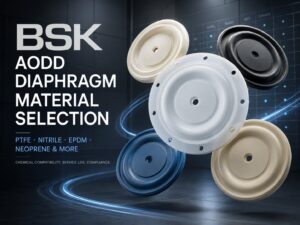
See our diaphragm material selection guide for the chemistry behind each elastomer and backing plate.

Choosing the Right Wetted Materials
Getting the wetted path right is the difference between a pump that lasts and one that plates out or pits in a month.
- Polypropylene (PP): the default for dyestuffs and mild alkali/acid; light, cheap, good to ~70 °C.
- PVDF: stronger chemical resistance and higher temperature (to ~90 °C) for bleach, acids and solvent-assisted printing.
- 316L stainless steel: when the stream is abrasive (mineral pigments, titanium dioxide) or you need manifold strength.
- PTFE diaphragms: best all-round chemical barrier for aggressive auxiliaries; pair with a compatible backup elastomer.
- Elastomers: Buna-N for general dye liquors, fluoroelastomer (FKM) for solvent and bleach duty, EPDM for caustic.
Avoid bare carbon steel and copper alloys where they could taint pastel or white goods—metal pick-up shows as spots after steaming.

Sizing Flow and Pressure for Dye Kitchens & Print Heads
Size to the batch, not the peak.
- Dye kitchen transfer: 500–3,000 L batches moved in 10–30 min → 3–6 m³/h is typical; allow 10 m³/h headroom.
- Rotary / flat-bed print paste feed: steady 0.5–3 m³/h at the pan, with pulses smoothed by a small header tank.
- Jet and beam machine fill/drain: 10–40 m³/h, pressure 4–7 bar to overcome hose and heat-exchanger loss.
- Air supply: 5–7 bar clean, dry air; size the compressor so the pump sees at least 5.5 bar at the inlet.
- Port size: 1″–2″ (DN25–DN50) covers most dye-house duties; go 3″ only for slurry waste.
A pump sized 3× the real need short-cycles, wastes compressed air and beats the diaphragms.

Typical Applications on a Dyeing & Printing Line
- Dye and pigment paste transfer from store to dye kitchen and kitchen to machine.
- Printing paste (thickener + pigment) supply to rotary/flat-bed print heads.
- Metered addition of auxiliaries—salt, soda ash, reducing agent—into the circulating bath.
- Spent dye liquor and wash-down to effluent, then sludge and print-back to the filter press.
- Desizing, scouring and bleaching liquors in pretreatment.
Each duty has a different abuse profile; matching material and size to the stream is what keeps the line running.
Common Sizing & Material Mistakes
- Oversizing “for safety”: a too-big pump short-cycles, deadheads on closed valves and cracks diaphragms.
- Wrong elastomer: a Buna-N diaphragm in bleaching range swells and tears in weeks—specify FKM or PTFE.
- Poor colour changeover: skipping the flush lets one shade contaminate the next; a quick strip-and-rinse routine pays back fast.
- Ignoring air quality: water and oil in the air line are the silent killers of diaphragm life—fit a coalescing filter.
- Forgetting abrasion: mineral pigments in PP bodies score the manifolds; step up to 316L or a ceramic-filled compound.
Selection Checklist
Before you specify, confirm: fluid (dyestuff, paste, aux, waste), solids and abrasiveness, temperature and pH, batch size and cycle time, and whether the area is zoned. Match the wetted material, size to the batch, and protect the air line. Our guides on diaphragm materials, adhesive transfer and electroplating cover the same logic across other viscous and corrosive streams.
Explore BSK Pneumatic Diaphragm Pumps
Looking for the right AODD pump for your application? BSK Fluid Technology offers a complete range of pneumatic diaphragm pumps in aluminum, stainless steel, cast iron, PP, and PVDF. With 30+ years of manufacturing expertise and patented ceramic air valve technology, we deliver reliable fluid transfer solutions worldwide.
Frequently Asked Questions
How can I control the flow rate of an AODD pump?
Flow is controlled by adjusting air pressure (simplest), installing a needle valve on the air supply, throttling the discharge valve (AODD pumps can dead-head safely), or using a solenoid valve with a PLC for batch dosing. Never throttle the suction side, as this causes cavitation.
What is an air-operated double diaphragm (AODD) pump?
An AODD pump is a positive displacement pump powered by compressed air. Two flexible diaphragms connected by a common shaft are driven back and forth by an air valve. When one diaphragm pushes fluid out, the other draws fluid in, creating continuous flow. AODD pumps are self-priming, can run dry, need no electricity, and handle a wide range of viscosities and solids.
How do I select the right AODD pump size (flow rate)?
BSK AODD pumps range from 1/4" (20-30 L/min) to 3" (900-1000 L/min). Select a pump that delivers 20-30% more flow than your minimum requirement so you can throttle for longer diaphragm life. Port sizes: 1/4" for lab/dosing, 1" for general industrial, 2" for large transfer, 3" for bulk/mining applications.
What air pressure does an AODD pump need?
BSK AODD pumps operate between 2-7 bar (30-100 PSI). The patented ceramic air valve allows an ultra-low 0.6 bar start pressure (competitors need 1.5-2 bar). The optimal operating range is 3-6 bar for the best balance of flow, energy use, and diaphragm life.
Where can I get a quote for the right AODD pump for my application?
BSK Fluid Technology engineers provide a personalized pump selection within 24 hours. Share your fluid properties, flow rate and pressure requirements via the Contact page or WhatsApp +86-134-3105-8937, and we will recommend the optimal model from our aluminum, stainless steel, cast iron, PP and PVDF AODD range.