Adhesives—whether water-based wood glue, solvent-borne contact cement, or filled epoxy—are some of the trickiest fluids to move. They are viscous, often shear-sensitive, and many contain fillers or abrasive particles that wear out ordinary pumps. For these reasons, air-operated double-diaphragm (AODD) pumps have become a standard choice on adhesive mixing, metering, and drum-transfer lines. This guide explains when an AODD pump is the right tool, what to watch for when specifying one, and how to keep it running reliably.
Quick note on wording: a “booster pump” only raises the pressure of an existing stream—it does not draw adhesive out of a drum. For actually transferring adhesive you need a positive-displacement transfer pump such as an AODD unit, with a booster added downstream only if the applicator needs higher pressure than the pump alone can supply.

Why AODD Pumps Suit Adhesive
- High-viscosity handling. AODD pumps move fluids well beyond what centrifugal pumps manage—typically up to tens of thousands of centipoise—because displacement does not depend on centrifugal force.
- Self-priming and dry-run safe. They prime from dry and survive brief running dry, which matters when a drum or tote runs empty mid-batch.
- Low shear. The diaphragm stroke is gentle on thixotropic and shear-thinning adhesives, so viscosity stays stable through the pump.
- Explosion-proof air drive. Compressed-air operation needs no electric motor in the hazardous area—important for solvent-based adhesives.
- Easy cleaning. Flush the wetted path with a compatible solvent or water; there is no complex rotor/stator assembly to strip down.
- Variable flow and pressure. Simply adjust the air supply pressure to match the line and the applicator.

Key Selection Factors
- Viscosity and temperature. Read the adhesive’s centipoise value at your operating temperature—viscosity rises sharply as the fluid cools. Size the pump and ports for the worst-case cold viscosity, not the warm lab figure.
- Chemistry. Solvent-based adhesives can swell or attack some elastomers; water-based grades are gentler. Confirm compatibility before specifying.
- Fillers and abrasives. Silica, calcium carbonate, or glass beads accelerate wear on diaphragms and check-valve balls. Choose abrasion-resistant materials and budget for spares.
- Required flow and discharge pressure. Include line losses from hose length, fittings, and the applicator. The available air pressure must overcome total discharge pressure plus friction.
- Duty cycle. Continuous metering versus intermittent drum transfer changes cooling and wear expectations—size accordingly.
Where AODD Pumps Are Used for Adhesive
AODD pumps appear wherever a viscous, sometimes filled or solvent-borne adhesive has to be moved accurately and safely. Common lines include:
- Woodworking & panel lamination. PVAc (white/yellow wood glue) and urea-formaldehyde resins are transferred and metered to spreaders and laminators without foaming.
- Packaging & case sealing. Cold glues and resealable adhesives are dosed to case erectors and carton sealers; the pump handles the viscosity swing as the drum cools.
- Automotive & assembly. Structural adhesives, seam sealers, and window-bonding compounds are dispensed with the pulse-free, variable-pressure control an AODD gives.
- Construction. Tile adhesive, flooring compound, and grout are drum-emptied and pumped to the point of use, including abrasive-filled grades.
- Electronics & potting. Encapsulation and potting resins are transferred in small, controlled volumes where low shear protects filler suspension.
Elastomer and Wetted-Part Selection
| Component | Water-based | Solvent-based | Filled / abrasive |
|---|---|---|---|
| Diaphragm | EPDM or Buna-N (Nitrile) | Fluoroelastomer (FKM) or PTFE | PTFE or reinforced elastomer |
| Check-valve balls / seats | Buna-N or EPDM | FKM or PTFE | PTFE or hardened seats |
| Manifold / body | Polypropylene or aluminum | PVDF or stainless steel | Stainless steel |
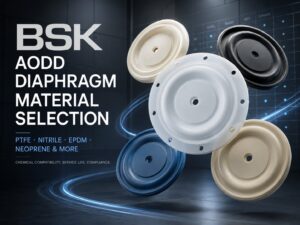
This table is a starting point, not a substitute for a chemical-compatibility check against the exact adhesive formulation. For a deeper look at how each diaphragm material behaves across chemicals, temperature, and abrasion, see our material-selection guide.

Sizing Tips
- Pick a pump whose maximum viscosity rating comfortably exceeds your adhesive’s cold viscosity.
- Use the largest practical inlet and outlet size to reduce friction and speed refill on viscous fluids.
- For very high viscosity, prefer flooded suction (submerged inlet or hopper feed) and slower cycling.
- Confirm the pump’s free-air consumption fits your compressor capacity, with margin for simultaneous tools.
Common Sizing Mistakes to Avoid
- Sizing for warm-lab viscosity. Adhesives thicken as they cool; the pump that flows freely at 25°C may stall at 15°C. Always size to the coldest operating point.
- Wrong elastomer for solvent. A nitrile or EPDM diaphragm can swell and fail in a solvent-borne adhesive. Match the elastomer to the chemistry before purchase.
- Undersized compressor. An AODD only delivers its rated flow if the air supply keeps up. Check free-air consumption against available compressor capacity.
- Long, narrow suction line. A thin or extended suction hose starves a viscous adhesive; keep the line short and large-bore, close to the source.
Installation and Maintenance
- Mount the pump close to the source and keep the suction line short and large-bore.
- Flush the pump with a compatible solvent (or water for water-based adhesives) immediately after use to prevent curing inside the wetted path.
- Keep spare diaphragms, valve balls and seats, and O-rings on hand to minimize downtime.
- If the adhesive off-gases or cures quickly, avoid dead legs and flush promptly at end of shift.

Quick Selection Checklist
- Viscosity (cP) at minimum and maximum operating temperature is known
- Adhesive chemistry (water-based / solvent / filled) is identified
- Required flow and discharge pressure, including line loss, are calculated
- Elastomer compatible with the chemistry is chosen
- Abrasion-resistant parts are specified if the adhesive is filled
- Compressor capacity covers the pump’s free-air consumption
- A compatible flush/cleaning solvent is available on site
Frequently Asked Questions
Can a booster pump transfer adhesive?
A booster only adds pressure to an existing stream; it does not draw adhesive from a drum. Use an AODD transfer pump, and add a booster only if the applicator needs higher pressure than the pump provides.
Will the pump damage a shear-thinning adhesive?
AODD pumps are low-shear, so most shear-thinning adhesives pass through with stable viscosity. Avoid high-speed positive-displacement designs if shear is a concern.
What about hot-melt adhesive?
Hot-melt is handled by heated melt systems, not standard AODD pumps. Use an AODD pump for solvent-based and water-based viscous adhesives instead.
BSK AODD pumps cover a wide range of flow rates and wetted materials for adhesive transfer, metering, and drum-emptying duties. If you are specifying a pump for a new adhesive line, share the viscosity, chemistry, and required flow with our engineers and we will size the right unit for you. For help choosing the right diaphragm material, our selection guide is a good place to start.
Explore BSK Pneumatic Diaphragm Pumps
Looking for the right AODD pump for your application? BSK Fluid Technology offers a complete range of pneumatic diaphragm pumps in aluminum, stainless steel, cast iron, PP, and PVDF. With 30+ years of manufacturing expertise and patented ceramic air valve technology, we deliver reliable fluid transfer solutions worldwide.
Frequently Asked Questions
Can an AODD pump run dry without damage?
Yes. AODD pumps can run dry indefinitely without damage, unlike centrifugal pumps that suffer seal failure. Prolonged dry running does accelerate diaphragm wear, so we recommend a liquid-level sensor or timer to stop the air supply when the source is empty.
How can I control the flow rate of an AODD pump?
Flow is controlled by adjusting air pressure (simplest), installing a needle valve on the air supply, throttling the discharge valve (AODD pumps can dead-head safely), or using a solenoid valve with a PLC for batch dosing. Never throttle the suction side, as this causes cavitation.
What is an air-operated double diaphragm (AODD) pump?
An AODD pump is a positive displacement pump powered by compressed air. Two flexible diaphragms connected by a common shaft are driven back and forth by an air valve. When one diaphragm pushes fluid out, the other draws fluid in, creating continuous flow. AODD pumps are self-priming, can run dry, need no electricity, and handle a wide range of viscosities and solids.
How do I select the right AODD pump size (flow rate)?
BSK AODD pumps range from 1/4" (20-30 L/min) to 3" (900-1000 L/min). Select a pump that delivers 20-30% more flow than your minimum requirement so you can throttle for longer diaphragm life. Port sizes: 1/4" for lab/dosing, 1" for general industrial, 2" for large transfer, 3" for bulk/mining applications.
Where can I get a quote for the right AODD pump for my application?
BSK Fluid Technology engineers provide a personalized pump selection within 24 hours. Share your fluid properties, flow rate and pressure requirements via the Contact page or WhatsApp +86-134-3105-8937, and we will recommend the optimal model from our aluminum, stainless steel, cast iron, PP and PVDF AODD range.