Electroplating and surface-treatment lines move some of the most aggressive liquids in any factory: acid and alkaline baths, chromic and sulfuric solutions, cyanide electrolytes, and rinse waters loaded with fines. A leak or a spark in that environment is not a maintenance nuisance—it is a safety and quality event. This guide explains why air-operated double-diaphragm (AODD) pumps have become the default choice for plating circulation, filtration, and chemical transfer, and how to size and specify one without the usual mistakes.

Why Electroplating Lines Need a Different Kind of Pump
Plating solutions are corrosive by design. Even a “mild” nickel or zinc bath runs at a low or high pH, and brighteners, wetting agents, and hardness-control additives make the chemistry worse over time. Three conditions decide the pump:
- Chemical attack on wetted parts. The pump must survive the bath, not just move it.
- Solids in suspension. Drag-out sludge, carbon from filters, and precipitated salts wreck close-clearance pumps.
- Explosion-risk atmosphere. Plating shops combine flammable solvents, hydrogen off-gassing, and electrical equipment; a grounded, air-driven pump removes a major ignition source.
A centrifugal or seal-bearing pump introduces a rotating shaft through a mechanical seal—exactly where corrosive liquid meets air, and exactly where leaks start.
What Makes AODD Pumps a Natural Fit
An AODD pump has no rotating shaft in the liquid and no mechanical seal. Two diaphragms on a shared air valve shuttle fluid through check valves; the process liquid never touches the air section. That single design choice solves most plating-line problems:
- No leak path at a shaft seal. The only seals are the diaphragm and check-valve balls—both fully contained.
- Intrinsically safe, air-driven. No electric motor at the pump, so no spark source in a hydrogen- or solvent-rich bay.
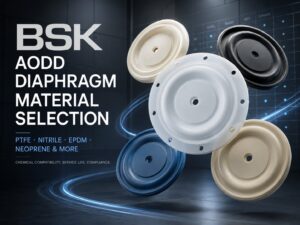
- Corrosion-proof material options. Fluid ends are molded in polypropylene (PP) or PVDF, with PTFE or engineered-elastomer diaphragms—see our AODD diaphragm material selection guide for the full compatibility picture.
- Runs dry without damage. Loss of prime or an empty sump will not seize the pump.
- Self-priming and handles solids. Sludge, carbon, and drag-out pass through; the pump reprims from a dry start.
- Throttle by air. Open the air regulator and flow scales instantly—handy for dosing brighteners or balancing circulation.

Choosing the Right Wetted Materials
The pump is only as corrosion-resistant as its fluid-end materials. Match them to the bath, not to the price list.
Pump body
- Polypropylene (PP): the workhorse for most acid/alkali plating solutions at moderate temperature. Low cost, broad chemical resistance.
- PVDF (Kynar): stronger chemical and temperature resistance than PP—specify it for chromic acid, hot baths, or aggressive oxidizers.
- 316 stainless: mechanically tough but not a universal answer; many plating acids attack it. Reserve for specific compatible electrolytes.
- Avoid uncoated aluminum in acidic baths—it dissolves fast.
Diaphragm and check valves
- PTFE (Teflon): best chemical resistance, lower flex life—use where compatibility is the constraint.
- Santoprene / thermoplastic elastomer: excellent flex life and good chemical range for general plating.
- Check-valve balls and seats should match the body material (PTFE or PVDF) so there is no weak link.
For a deeper material-vs-chemical breakdown, read our AODD diaphragm material selection guide.

Sizing Flow and Pressure for Plating Circulation
Most plating pumps do not push liquid to a height—they circulate it through a filter and back to the tank. Size for turnover, not just head.
- Circulation rate: target 4–10 tank volumes per hour through the filter, so the bath stays uniform and fines are removed. A 1,000 L nickel tank wants roughly 70–170 L/min of circulation.
- Head: the pump must overcome filter pressure drop, pipe losses, and the lift from sump to tank rim. AODD pumps comfortably hold 4–7 bar; size the air supply, not just the pump.
- Port size: plating circulation commonly starts at 1/4″ (DN8) for lab and dosing lines and scales up with tank size. Do not oversize—too large a pump short-cycles and wastes air.
- Air supply: clean, dry, regulated air at the rated pressure. Moisture in the air line is the silent killer of diaphragm life.
If you also move high-viscosity chemistries such as adhesives or thick coatings, the same AODD principle applies—our adhesive-transfer guide covers viscosity and shear.

Typical Applications on the Line
- Bath circulation and filtration: the core job—keep every liter of plating solution moving through the filter.
- Chemical dosing: metered addition of brighteners, inhibitors, and pH adjusters via the air throttle.
- Rinse-water and effluent transfer: move drag-out and wash water to treatment.
- Anodizing and conversion coatings: sulfuric or chromic anodize baths, where PVDF fluid ends shine.
- Sludge and spent solution: pump out precipitated salts and filter cake without a seal to clog.
Common Selection Mistakes to Avoid
- Spec’ing a metal pump for a corrosive bath “because it is stronger.” 316 SS still corrodes in acid; the leak shows up as rejected parts.
- Ignoring diaphragm compatibility. A wrong diaphragm fails in days and dumps bath into the air section.
- Undersizing circulation. Low turnover means thickness variation across the rack—a quality complaint, not a pump complaint.
- Overlooking the air line. Dirty or unregulated air shortens diaphragm life more than the bath does.
- Forgetting explosion protection. An electric pump in a hydrogen-rich bay trades a small saving for a real hazard.
Conclusion
AODD pumps earn their place on electroplating and surface-treatment lines by removing the two things those lines cannot tolerate: leaks and ignition sources. Choose PP or PVDF fluid ends, match the diaphragm to the bath, size for turnover, and feed it clean dry air. BSK supplies PP and PVDF AODD pumps sized for plating circulation, dosing, and effluent—tell us your bath chemistry and tank volume and we will specify the right unit.
Explore BSK Pneumatic Diaphragm Pumps
Looking for the right AODD pump for your application? BSK Fluid Technology offers a complete range of pneumatic diaphragm pumps in aluminum, stainless steel, cast iron, PP, and PVDF. With 30+ years of manufacturing expertise and patented ceramic air valve technology, we deliver reliable fluid transfer solutions worldwide.
Frequently Asked Questions
How do I select the right AODD pump size (flow rate)?
BSK AODD pumps range from 1/4" (20-30 L/min) to 3" (900-1000 L/min). Select a pump that delivers 20-30% more flow than your minimum requirement so you can throttle for longer diaphragm life. Port sizes: 1/4" for lab/dosing, 1" for general industrial, 2" for large transfer, 3" for bulk/mining applications.
What air pressure does an AODD pump need?
BSK AODD pumps operate between 2-7 bar (30-100 PSI). The patented ceramic air valve allows an ultra-low 0.6 bar start pressure (competitors need 1.5-2 bar). The optimal operating range is 3-6 bar for the best balance of flow, energy use, and diaphragm life.
How do I choose the right diaphragm material?
PTFE (Teflon) for strong acids, alkalis and solvents; Santoprene for general purpose, food-grade and mild chemicals (longer life); Viton (FKM) for oils, fuels and high temperature; Nitrile (Buna-N) for petroleum and wastewater. BSK also offers PTFE-backed Santoprene composite diaphragms combining chemical resistance with long flex life.
Can an AODD pump run dry without damage?
Yes. AODD pumps can run dry indefinitely without damage, unlike centrifugal pumps that suffer seal failure. Prolonged dry running does accelerate diaphragm wear, so we recommend a liquid-level sensor or timer to stop the air supply when the source is empty.
Where can I get a quote for the right AODD pump for my application?
BSK Fluid Technology engineers provide a personalized pump selection within 24 hours. Share your fluid properties, flow rate and pressure requirements via the Contact page or WhatsApp +86-134-3105-8937, and we will recommend the optimal model from our aluminum, stainless steel, cast iron, PP and PVDF AODD range.