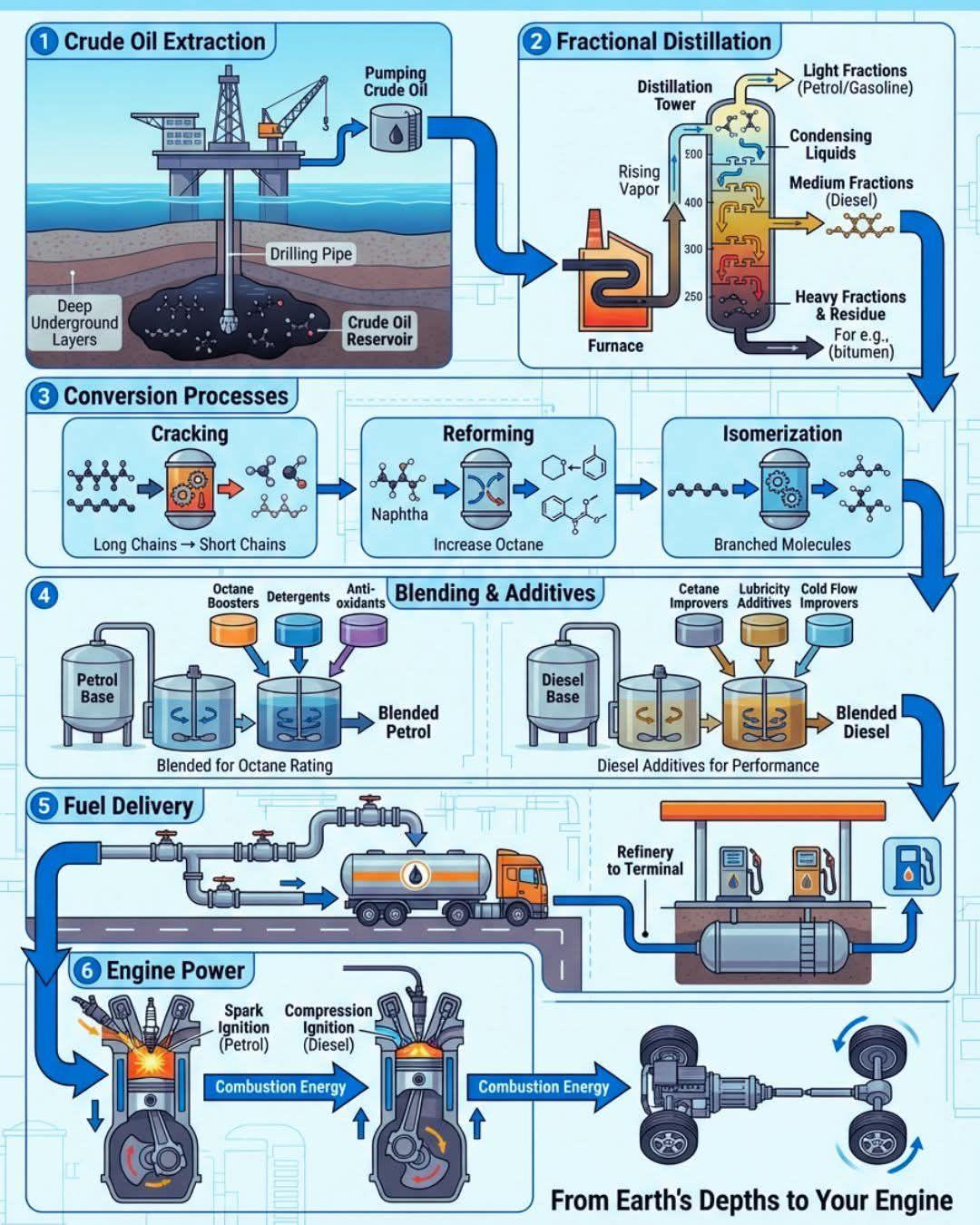
From crude oil extraction in underground reservoirs to fractional distillation and conversion at refineries, and finally to the terminal distribution of refined products, every link in the oil and gas industry chain relies on efficient and safe fluid transportation equipment. Pneumatic diaphragm pumps, with their inherent explosion-proof design, leak-proof properties, and strong self-priming capabilities, have become essential equipment tailored for the demanding operating conditions of the oil and gas sector. These pumps play a critical role in all six core processes marked in the flowchart, serving as the “invisible lifeline” that ensures the safe and stable operation of the industry.
I. Crude Oil Extraction: From Oil Wells to Source Assurance of Gathering and Transportation
The first step in the flowchart is crude oil extraction, marking the starting point of the oil and gas industry chain. This phase faces multiple challenges including sand content, gas contamination, and complex geological conditions. Pneumatic diaphragm pumps are utilized throughout the entire oil production process: During oil well pumping operations, their capability to transport gas-and solid-containing multiphase crude oil effectively resolves gas lock and pump jamming issues common in traditional pumping units, making them particularly suitable for low-yield wells and intermittent wells. In drilling operations, these pumps efficiently convey high-viscosity drilling mud and fracturing fluids, ensuring continuous drilling and reservoir modification activities through their wear-resistant and leak-proof properties. Additionally, in scenarios such as wellhead crude oil gathering and transportation, well maintenance wax removal, and storage tank dredging, the self-priming capacity and mobile deployment capabilities of pneumatic diaphragm pumps further enhance operational efficiency and safety standards across extraction processes.
II. Crude Oil Refining: Core Hub for Fractionation Conversion and Blending
Steps two to four in the flowchart encompass three core refining processes: fractionation, conversion, and blending, representing the most extensive application areas for pneumatic diaphragm pumps. During fractionation, high-viscosity residual oil, asphalt, and tower bottom residues at the fractionation tower’s base require stable transportation through pneumatic diaphragm pumps. Their high-temperature resistance and viscosity tolerance effectively mitigate cavitation issues common in centrifugal pumps. In conversion processes, various fluid transfers—including cracking catalyst slurry, reforming naphtha, and isomerization reaction media—are accomplished using pneumatic diaphragm pumps. Their explosion-proof design and leak-proof construction eliminate risks of light hydrocarbon leakage and explosions. For oil blending operations, precise dosing of additives such as gasoline octane improvers and diesel cetane improvers is also managed by pneumatic diaphragm pumps. By regulating intake pressure, these pumps enable accurate control of additive flow rates to ensure product quality compliance, while their leak-proof design prevents pollution and waste caused by additive volatilization.
III. Fuel Storage, Transportation, and Terminal Distribution: The Circulatory Artery from Refinery to Engine
The fifth step of fuel distribution and the sixth step of engine power in the flowchart constitute the circulation chain of refined oil products from refineries to vehicle terminals, where pneumatic diaphragm pumps remain indispensable. During refined oil loading/unloading operations between refineries and oil depots, their mobile deployment capabilities and strong self-priming characteristics meet the rapid loading/unloading requirements of tanker trucks and oil tankers, while their inherent explosion-proof design complies with safety regulations for hazardous environments at oil depots and ports. For underground oil tank unloading operations at gas stations, transfer operations, and auxiliary fuel supply by fuel dispensers, these pumps’ low-noise operation and leak-proof design ensure safe and environmentally compliant operations. Additionally, pneumatic diaphragm pumps play critical roles in supporting processes such as oil tank cleaning and vapor recovery system transportation, facilitating terminal maintenance and environmental compliance standards.
IV. Application Value and Industry Prospects
The pneumatic diaphragm pump has become a core transportation solution in the oil and gas industry by precisely meeting stringent operational requirements: powered by compressed air, it completely eliminates electrical sparks and ensures safe operation in Zone 1 and Zone 2 hazardous environments. The diaphragm effectively isolates the transport medium from the power source, preventing leaks of flammable, explosive, or corrosive substances at the source. Additionally, its dry-running capability, compatibility with multiple media types, and low maintenance costs significantly reduce operational expenses for equipment in the oil and gas sector.
As the oil and gas industry transitions toward intelligentization and green transformation, pneumatic diaphragm pumps are undergoing continuous upgrades. The integration of smart sensing technologies enables remote monitoring and automatic regulation, while specialized materials enhance corrosion and wear resistance. Energy-efficient structural designs further reduce energy consumption. Moving forward, pneumatic diaphragm pumps will continue to deepen their involvement across the entire oil and gas value chain, providing robust support for the industry’s safety, efficiency, and sustainable development.
Explore BSK Pneumatic Diaphragm Pumps
Looking for the right AODD pump for your application? BSK Fluid Technology offers a complete range of pneumatic diaphragm pumps in aluminum, stainless steel, cast iron, PP, and PVDF. With 30+ years of manufacturing expertise and patented ceramic air valve technology, we deliver reliable fluid transfer solutions worldwide.
Learn more: About BSK Fluid Technology | AODD Pump Products | Pump FAQ | Contact Our Engineering Team
Frequently Asked Questions
When should I choose PTFE vs Santoprene diaphragms?
Choose PTFE for strong acids, aggressive solvents, high-purity or temperatures above 80°C (shorter flex life, higher cost). Choose Santoprene for mildly corrosive/neutral fluids, longer diaphragm life (2-3x vs PTFE), food-grade use and cost efficiency.
Can BSK pumps handle food-grade and sanitary applications?
Yes. BSK sanitary AODD pumps feature a 316L body with electropolished finish (Ra ≤ 0.8 μm), tri-clamp connections for CIP, FDA-compliant diaphragms, and no dead legs for complete drainage. They are used in dairy, beverages, sauces, edible oils and chocolate transfer.
Are BSK pumps suitable for explosive / ATEX environments?
Yes. AODD pumps are powered by compressed air with no electricity, making them inherently safe for ATEX Zone 1/2 (gas) and Zone 21/22 (dust). For ATEX compliance use a conductive grounded metallic body or PTFE diaphragms with conductive additive for plastic bodies, and route the air exhaust to a safe area.
Why choose an AODD pump instead of a centrifugal pump?
AODD pumps excel with high-viscosity fluids (up to 10,000 cP), abrasive slurries and shear-sensitive liquids. They run dry without damage, are self-priming, handle solids up to 6mm, and are safe for explosive environments with no electricity. Centrifugal pumps suit very high flow (>1000 L/min) or high pressure (>10 bar).
Where can I get a quote for the right AODD pump for my application?
BSK Fluid Technology engineers provide a personalized pump selection within 24 hours. Share your fluid properties, flow rate and pressure requirements via the Contact page or WhatsApp +86-134-3105-8937, and we will recommend the optimal model from our aluminum, stainless steel, cast iron, PP and PVDF AODD range.