

In the food, dairy, beverage, and pharmaceutical industries, how liquids are treated is critical. One misstep in pump design or material selection can result in contamination, recalls, or expensive downtime. That’s why FDA and Sanitation Pump standards are so stringent. To exceed these high standards, one material outperforms the rest: 316 stainless steel.
But why is 316 stainless steel so unique? Why is it employed as the gold standard for FDA and Sanitation Pump applications, and why are leading manufacturers such as BSK using it to produce their pumps?
Let’s start with the material and drill down step by step, the surface finish, the cleaning process, and how it helps companies that rely on safe handling of liquids on a daily basis.
What Makes 316 Stainless Steel Stand Out in FDA and Sanitation Pump Design
When choosing a food or pharmaceutical pump, the first question is a simple one: what should it be made of? Most folks wrongly believe that all stainless steels are alike, but that is farther from the truth than they can even imagine.
316 vs 304 Stainless Steel
The two most widely used stainless steels are 304 and 316. Both are strong and resistant to corrosion, but 316 has another ingredient: molybdenum. This extra ingredient makes 316 more resistant to chloride attack, an area of concern in food processing facilities where salt, brine, and cleaners are applied. While 304 stainless steel will pit or corrode over time, 316 is stronger, with a smoother, safer surface.
Benefits of Food Safety
Why is that important to the FDA and the Sanitation Pump? Because once the surface begins pitting, microscopic crevices form that allow bacteria to live. No amount of cleaning will kill those microbes. By employing 316 stainless steel, pumps remain corrosion-resistant, much, much longer, which maintains their interior surfaces smooth and clean.
This strength is the first reason for using processors such as 316. But FDA and 3-A requirements call for more than a quality alloy. They also scrutinize the surface finish.
Why Sanitation Pump and FDA Standards Require Suitable Material
And why would the FDA be so interested in materials? The reason is the food and drug safety regulation.
FDA Compliance Simplified
The FDA doesn’t “approve” pumps in the way it approves drugs. What it does is require all product-contact material in pumps to be food safe. On stainless steel, this would mean that the alloy itself must be non-toxic, must be resistant to corrosion, and must be capable of repeated cleaning without deterioration. 316 stainless steel meets all these requirements and is therefore the safest material to use in FDA and Sanitation Pumps.
3-A Sanitary Standards
Additionally, aside from FDA requirements, nearly all of the processors also follow 3-A Sanitary Standards.
These are design specification standards for pumps and other machinery. One of the stricter requirements is that the surface roughness must be below Ra 0.8 microns. This renders the pump smooth enough so that it can be properly cleaned, with no residual left behind.
316 stainless steel not only fulfills this requirement but remains as good as new even after decades of service. That makes it an investment of choice for manufacturers who cannot spare downtime or contamination.
But surface finish deserves special mention since it has a direct impact on hygiene.
The Role of Surface Finish in FDA and Sanitation Pump Performance
Even the best stainless steel is useless if the surface is not correctly finished. Something that feels smooth can actually still have very tiny valleys in which food particles can be captured or in which bacteria can be grown. Surface finish is therefore gauged with high precision.
Why Ra0.8 Matters
The FDA Sanitation Pump standard is Ra0.8 microns, or 32 microinches. Polishing to this degree will create a surface smooth enough to keep bacteria from growing on it and clean enough to be easily cleaned out on CIP cycles. Polishing anything finer than this has the potential to trap residues that compromise safety.
Mechanical vs Electropolishing
There are two main ways of achieving this finish. Mechanical polishing smooths the surface by abrasive methods, and electropolishing removes a thin metal layer by an electrochemical process. Both are Ra0.8 capable, but mechanically polished is more common and cheaper. For most applications, like BSK’s FDA and Sanitation Pumps designs, it achieves only the level of cleanliness needed.
With the correct surface finish, pumps are much easier to clean. And that takes us to one of the most significant aspects of sanitation design: Clean-In-Place systems.
How Clean-In-Place and Self-Draining Design Ensure FDA and Sanitation Pumps Safety
Even stainless steel, the smoothest of the bunch, needs regular cleaning to be sanitary. That is where Clean-In-Place, or CIP, comes in.
The Basics of CIP
CIP is a process that is capable of cleaning pumps and pipes without the removal of parts. Cleaning solutions are forced through the system at high velocity, removing soils, residues, proteins, and fats. A high-alkaline wash is often followed by an acid rinse. 316 stainless steel is appropriate for this use since it can withstand the alkaline and acidic cleaning solutions.
Why Self-Draining Design Matters
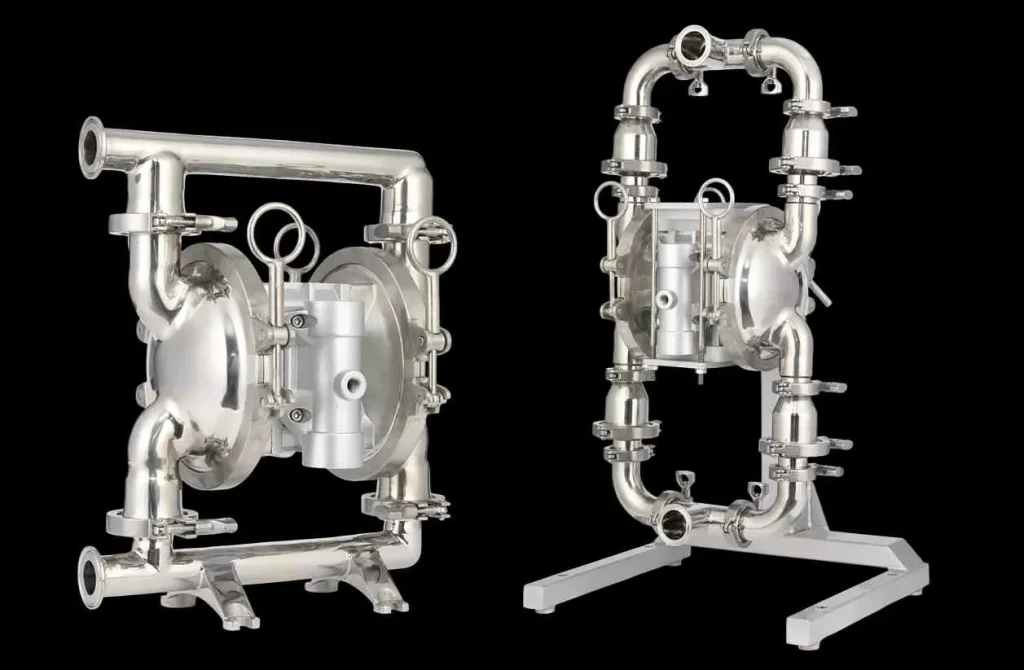
The other most important aspect of FDA and Sanitation Pump safety is self-draining geometry. Pumps that retain liquid for cleaning purposes become dirty again almost instantly. This is why BSK pumps are designed to fully drain when properly installed. This means that absolutely every drop of water or cleaning solution is removed from the pump, with no opportunity for bacteria to form.
By marrying the strength of 316 stainless steel with a Ra0.8 finish and good CIP and drainability, pumps can reliably meet FDA and 3-A sanitary requirements. But not every manufacturer is so particular.
The Benefits of Choosing BSK for FDA and Sanitation Pump Needs
When selecting an FDA and Sanitation Pump application supplier, it’s not just the material. It is the philosophy behind the design.
BSK manufactures its pumps with all parameters in mind for hygiene and performance. The wetted components are built using 316 stainless steel. All interior and exterior surfaces are Ra0.8 polished for cleanliness. The pumps are self-draining and CIP, and no residue is present once cleaning is complete.
BSK also has a wide range of pump sizes to choose from, ranging from 1 inch to 4 inches, so they can be used on everything from small specialty applications to big industrial plants. Companies are able to ensure consistency for all of their sanitary pumping applications by having only one dependable supplier.
Aside from being clean, there are also practical advantages. Three hundred sixteen stainless steel pumps and polished finishes simply last longer and are less expensive in the long run.
Why Investing in the Right FDA and Sanitation Pump Is Worth It in the End
The overwhelming majority of managers consider the first cost of equipment, but the true cost of a pump is product safety, downtime, and maintenance.
Fewer Downtimes
When pumps corrode or fail prematurely, production is disrupted. A lost hour of production can run into thousands of dollars, and then there is the loss of customer trust if contaminated product finds its way into the marketplace. By employing 316 stainless steel pumps, processors prevent these risks and maintain their lines.
Improved Audit Outcomes
Food and drug production facilities undergo regular audits and inspections. Equipment built to comply with FDA and 3-A protocols makes it easier to pass audits, and therefore, there are no costly delays or penalties. Self-draining pumps with simple-to-clean pumps reduce the space auditors have to find defects.
Extended Equipment Life
Finally, there is the question of longevity. A properly maintained 316 stainless steel FDA and Sanitation Pump will outlast a pump constructed of less costly materials by decades. In the end, the savings in replacements and lost downtime are well worth the additional expense of the initial purchase.
So what does all that look like to processors deciding what pump to buy? It means that 316 stainless steel is not just about compliance—it is about designing a safer, more efficient, and more profitable operation.
Conclusion
From 316 stainless steel durability to Ra0.8 high-polish precision, no aspect is too small for hygienic pumping. FDA and Sanitation Pump applications require constructions and materials that tolerate no compromise. With Clean-In-Place functionality, self-draining design, and corrosion protection with longevity, BSK pumps are prepared to take on these demands head-on.
If your business needs pumps that provide food safety, dependability, and regulatory compliance, now is the time to act. Contact the BSK team today and learn how our FDA and Sanitation Pump solutions can benefit your organization. Our engineers stand ready to answer your questions and help you determine the best solution for your production line.
Explore BSK Pneumatic Diaphragm Pumps
Looking for the right AODD pump for your application? BSK Fluid Technology offers a complete range of pneumatic diaphragm pumps in aluminum, stainless steel, cast iron, PP, and PVDF. With 30+ years of manufacturing expertise and patented ceramic air valve technology, we deliver reliable fluid transfer solutions worldwide.
Frequently Asked Questions
How do I select the right AODD pump size (flow rate)?
BSK AODD pumps range from 1/4" (20-30 L/min) to 3" (900-1000 L/min). Select a pump that delivers 20-30% more flow than your minimum requirement so you can throttle for longer diaphragm life. Port sizes: 1/4" for lab/dosing, 1" for general industrial, 2" for large transfer, 3" for bulk/mining applications.
What air pressure does an AODD pump need?
BSK AODD pumps operate between 2-7 bar (30-100 PSI). The patented ceramic air valve allows an ultra-low 0.6 bar start pressure (competitors need 1.5-2 bar). The optimal operating range is 3-6 bar for the best balance of flow, energy use, and diaphragm life.
How do I choose the right diaphragm material?
PTFE (Teflon) for strong acids, alkalis and solvents; Santoprene for general purpose, food-grade and mild chemicals (longer life); Viton (FKM) for oils, fuels and high temperature; Nitrile (Buna-N) for petroleum and wastewater. BSK also offers PTFE-backed Santoprene composite diaphragms combining chemical resistance with long flex life.
Can an AODD pump run dry without damage?
Yes. AODD pumps can run dry indefinitely without damage, unlike centrifugal pumps that suffer seal failure. Prolonged dry running does accelerate diaphragm wear, so we recommend a liquid-level sensor or timer to stop the air supply when the source is empty.
Where can I get a quote for the right AODD pump for my application?
BSK Fluid Technology engineers provide a personalized pump selection within 24 hours. Share your fluid properties, flow rate and pressure requirements via the Contact page or WhatsApp +86-134-3105-8937, and we will recommend the optimal model from our aluminum, stainless steel, cast iron, PP and PVDF AODD range.


