
BSK Application Guide
Short Answer
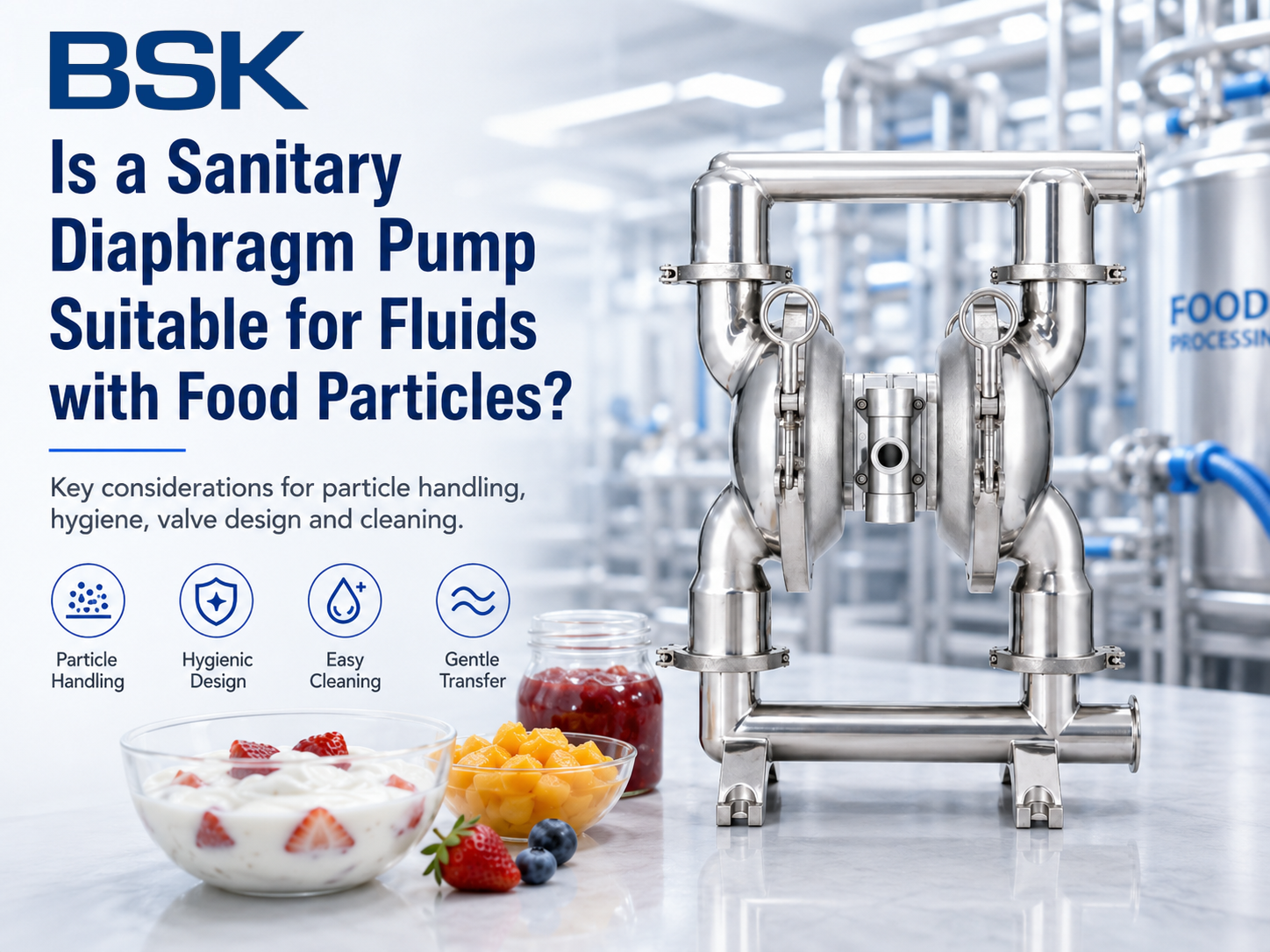
A sanitary diaphragm pump may be suitable for fluids containing food particles, but suitability depends on the complete application. Particle size alone is not enough. Buyers must also consider particle shape, softness, concentration, settling behavior, fluid viscosity, required flow, suction conditions, valve design, internal passage size, cleaning method, and product-damage limits. A pump described as sanitary is not automatically a solids-handling pump, and a pump that passes particles mechanically is not automatically appropriate for a hygienic process.
What Counts as a Food Particle?
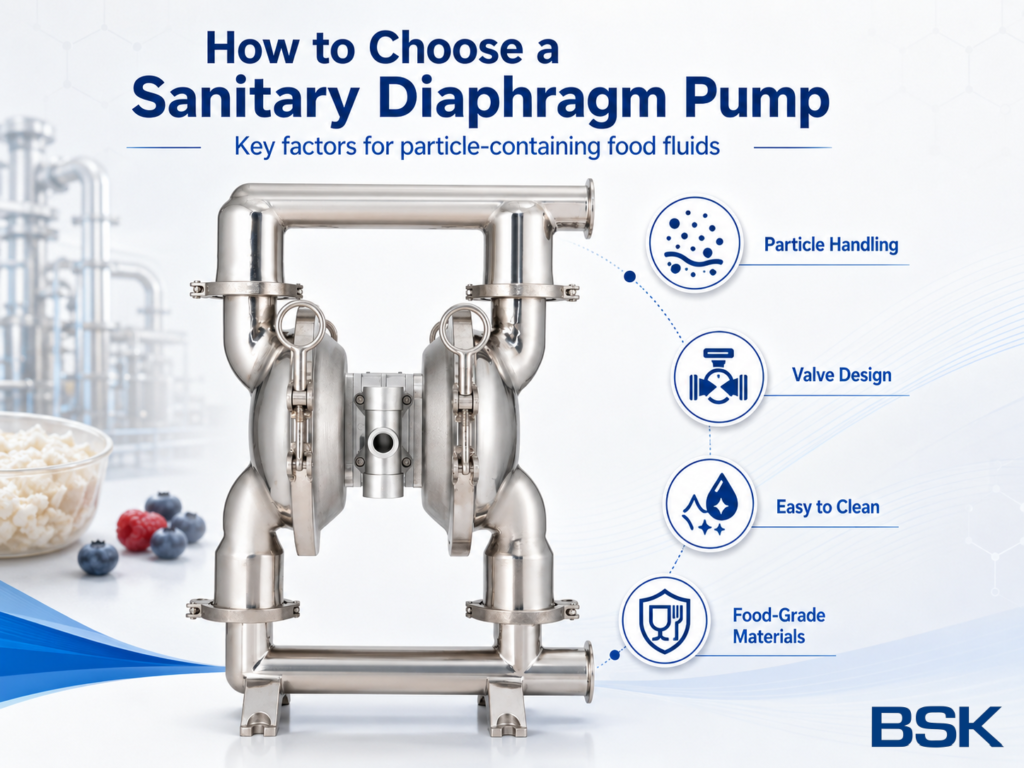
Food particles can range from soft fruit pieces and vegetable pulp to seeds, grains, spice fragments, meat pieces, curds, crystals, or suspended fibers. Their behavior differs greatly. A soft, deformable piece may pass through an opening that would block a rigid particle of the same nominal size. Long fibers can wrap or bridge, while dense particles may settle in slow areas. Buyers should provide the maximum particle dimensions, typical size distribution, shape, hardness, concentration, and whether the product separates during storage or transfer.
Why Valve Design Matters
The inlet and outlet valves determine how the pump chambers fill and discharge. Ball-valve pumps are widely used, but the ball, seat, passage, and manifold geometry limit what can pass. Particles can become trapped between a ball and seat, causing leakage or unstable cycling. Flap-valve configurations are often considered for larger or irregular solids because the flow path and valve movement can be more accommodating. This is a selection direction rather than a universal rule: the exact pump series, passage dimensions, orientation, and fluid behavior must be confirmed.
Particle Size Is Not the Only Limit
A simple statement such as “handles particles up to a certain size” can be misleading without model-specific data. The narrowest internal passage, valve opening, connection, manifold turn, and product consistency all matter. Particle concentration also changes performance. A liquid carrying occasional soft pieces behaves differently from a mixture packed with solids. If particles swell, agglomerate, freeze, or settle, the worst condition should be used for selection. Provide representative product samples or photographs when descriptions are difficult.
Protecting Product Integrity
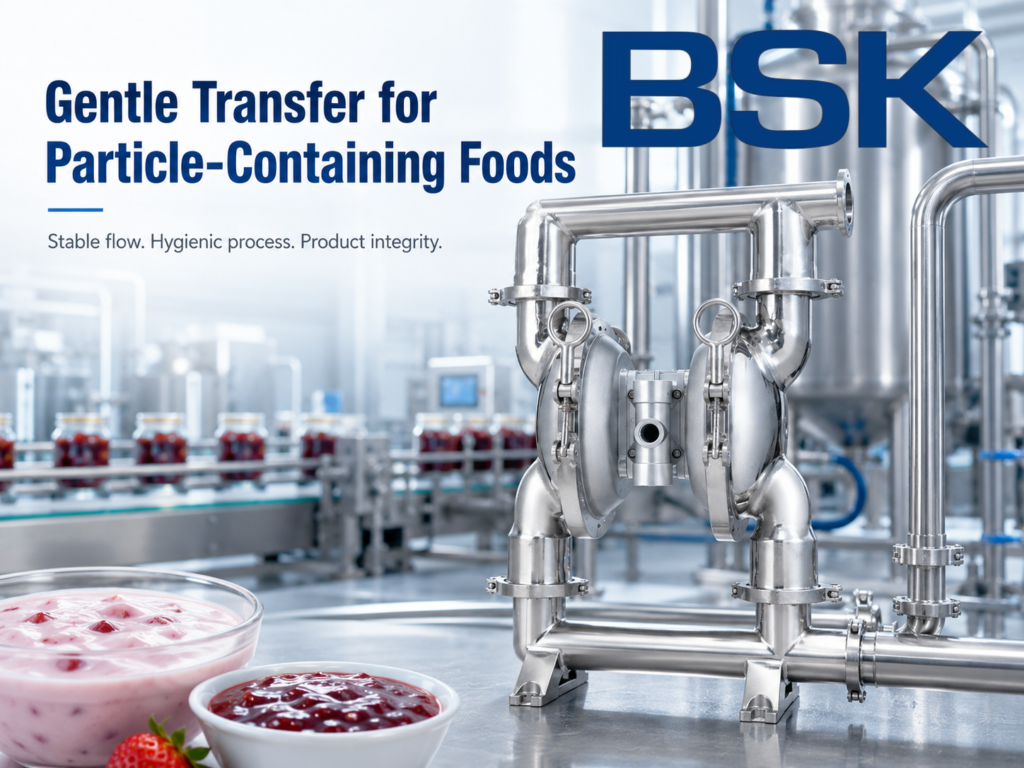
Some foods must be transferred without excessive cutting, crushing, foaming, or separation. A diaphragm pump can provide relatively gentle intermittent movement in suitable applications, but the result depends on pump speed, valve action, pressure, piping, particle fragility, and recirculation. Running faster to recover lost flow may increase product damage. If appearance or particle integrity is critical, define an acceptable result and consider a controlled trial with the actual product. A successful water test does not prove that fruit pieces, curds, or delicate inclusions will remain intact.
Viscosity and Suction Conditions
Many particle-containing foods are also viscous. Thick sauces, purees, fillings, and suspensions can fill the pump chamber more slowly than water. Long or narrow suction lines, excessive lift, small fittings, and restrictive strainers can reduce flow or promote separation. Keep the inlet line short and appropriately sized, and describe the minimum product temperature because viscosity may rise sharply when the food cools. Flooded suction may be helpful, but the source vessel and isolation arrangement must still support hygienic and safe maintenance.
Sanitary Design and Cleaning
Sanitary suitability involves more than stainless-steel appearance. The selected pump should be reviewed for wetted materials, surface and connection requirements, drainability, disassembly, cleaning procedure, elastomers, valve construction, and documentation expected by the customer. Food particles can remain in pockets or behind valves if the pump and piping are not cleaned correctly. State whether cleaning is manual, clean-in-place, or another validated method, and provide cleaning chemicals, temperatures, and sequence. Do not assume a certification or hygienic claim unless it is confirmed for the exact model and configuration.
Materials and Temperature
The pump body, diaphragms, valve components, seals, and connections must be compatible with both the food product and every cleaning fluid. Temperature affects chemical compatibility, elastomer behavior, viscosity, and product condition. Oils, flavors, acids, salts, sugars, alcohol, and cleaning agents may create different material requirements. If the same pump handles several recipes, provide the full product range and the strongest cleaning condition. A material selected for the main product can still fail because of a hot or aggressive wash cycle.
Questions to Answer Before Selection
Before asking for a model, document the product name, temperature, viscosity, particle dimensions and shape, solids concentration, required flow, transfer distance, suction arrangement, discharge pressure, connection preference, cleaning method, acceptable product damage, and operating schedule. Explain whether particles settle during pauses and whether the pump must restart with a full line. Also state any food-contact documentation, finish, or connection standards required by the project. These details determine whether a ball-valve sanitary pump, a flap-valve design, or another solution should be reviewed.
How BSK Can Help
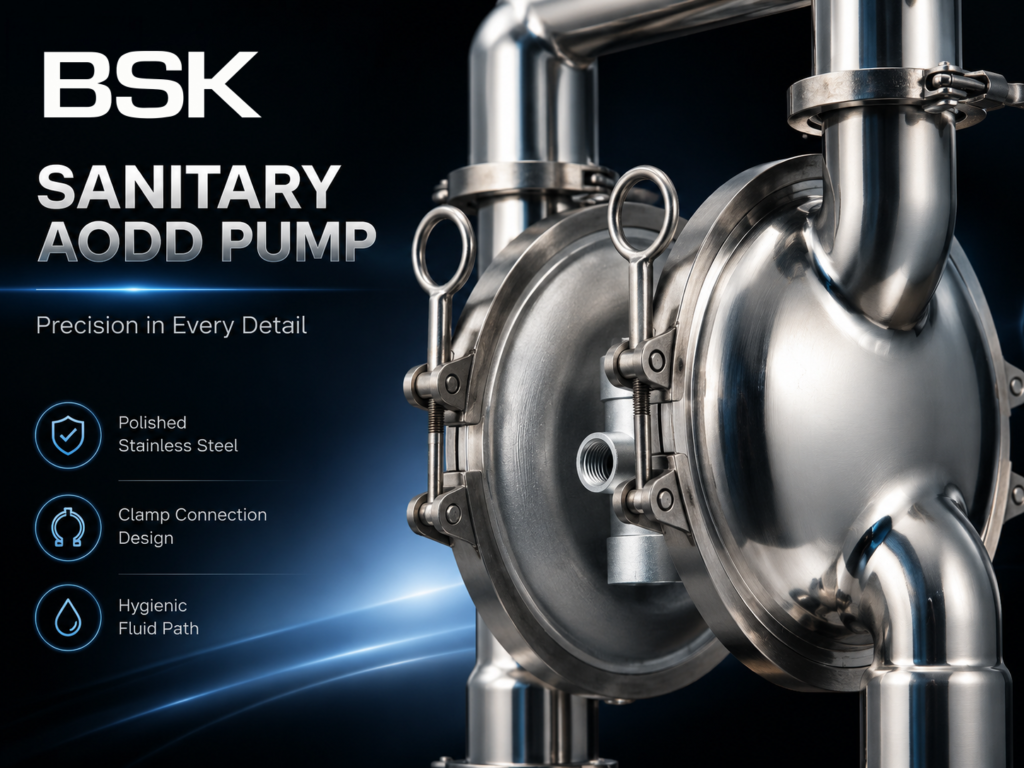
BSK Fluid Technology LLC. can review sanitary diaphragm pump applications using relevant FD or FS series information and the actual process conditions. Send product data, particle details, photographs if useful, duty requirements, piping layout, cleaning procedure, and documentation expectations. BSK can then discuss valve configuration, wetted materials, pump size, connections, and whether a product trial is advisable. Final suitability must be confirmed for the exact model, configuration, and food process before ordering.
Conclusion
A sanitary diaphragm pump can be a practical option for some food products containing particles, but the answer depends on more than a sanitary label. Particle geometry, concentration, valve design, internal passages, viscosity, suction conditions, product integrity, cleaning, materials, and documentation must all be reviewed. The strongest selection process uses complete product data and, for fragile or unusual inclusions, a controlled test with the real product.
Explore BSK Pneumatic Diaphragm Pumps
Looking for the right AODD pump for your application? BSK Fluid Technology offers a complete range of pneumatic diaphragm pumps in aluminum, stainless steel, cast iron, PP, and PVDF. With 30+ years of manufacturing expertise and patented ceramic air valve technology, we deliver reliable fluid transfer solutions worldwide.
Frequently Asked Questions
How do I select the right AODD pump size (flow rate)?
BSK AODD pumps range from 1/4" (20-30 L/min) to 3" (900-1000 L/min). Select a pump that delivers 20-30% more flow than your minimum requirement so you can throttle for longer diaphragm life. Port sizes: 1/4" for lab/dosing, 1" for general industrial, 2" for large transfer, 3" for bulk/mining applications.
What air pressure does an AODD pump need?
BSK AODD pumps operate between 2-7 bar (30-100 PSI). The patented ceramic air valve allows an ultra-low 0.6 bar start pressure (competitors need 1.5-2 bar). The optimal operating range is 3-6 bar for the best balance of flow, energy use, and diaphragm life.
How do I choose the right diaphragm material?
PTFE (Teflon) for strong acids, alkalis and solvents; Santoprene for general purpose, food-grade and mild chemicals (longer life); Viton (FKM) for oils, fuels and high temperature; Nitrile (Buna-N) for petroleum and wastewater. BSK also offers PTFE-backed Santoprene composite diaphragms combining chemical resistance with long flex life.
Can an AODD pump run dry without damage?
Yes. AODD pumps can run dry indefinitely without damage, unlike centrifugal pumps that suffer seal failure. Prolonged dry running does accelerate diaphragm wear, so we recommend a liquid-level sensor or timer to stop the air supply when the source is empty.
Where can I get a quote for the right AODD pump for my application?
BSK Fluid Technology engineers provide a personalized pump selection within 24 hours. Share your fluid properties, flow rate and pressure requirements via the Contact page or WhatsApp +86-134-3105-8937, and we will recommend the optimal model from our aluminum, stainless steel, cast iron, PP and PVDF AODD range.


