
How to Choose an AODD Pump for Chemical Transfer
Chemical transfer is one of the most common applications where buyers consider an air-operated double-diaphragm (AODD) pump. The duty may look simple at first: move a chemical from a drum, IBC, storage tank, mixing vessel, or treatment area to another process point. In practice, the pump must deal with corrosion risk, changing viscosity, vapor, solids, seal compatibility, cleaning requirements, and installation limits.
This article focuses on practical selection for buyers, engineers, and distributors who need to confirm pump body, diaphragm, valve, and installation conditions before ordering.
Where This Pump Is Commonly Used
An AODD pump for chemical transfer is often used where the fluid is not suitable for a simple clean-water transfer pump. Typical scenarios include transferring acids or alkalis, dosing treatment chemicals, unloading drums or IBCs, feeding a mixing tank, transferring wastewater chemicals, and handling coating additives.
The application can be batch-based, intermittent, or part of a regular transfer line. Some buyers need a compact pump for limited space, while others need a larger pump for tank-to-tank transfer.
The key point is that chemical transfer is not one single duty. The same pump name may appear on different inquiries, but the actual fluid, temperature, viscosity, piping, and working environment can be very different.
Typical Problems in This Application
Chemical transfer problems usually appear after the pump is installed, not during quotation. A common issue is fluid leakage caused by unsuitable seals, diaphragm wear, loose connections, or chemical attack on wetted parts. Another frequent issue is corrosion, especially when buyers select pump body material only by price or by a general description such as “chemical resistant.”
Unstable flow can happen when the suction line is too long, the fluid is viscous, the inlet is restricted, or the pump cycles too fast for the system. Some users also complain about air consumption when the pump is oversized, the air line is poorly arranged, or the duty point was not clearly defined.
Maintenance difficulty is another real concern. If the pump is installed too close to a wall, tank, or frame, technicians may not have enough space to inspect diaphragms, valve balls, seats, and manifolds. For fluids with solids or crystallization risk, ignoring cleaning access can quickly turn a small selection mistake into repeated downtime.
Key Pump Selection Factors
Before selecting a pneumatic diaphragm pump for chemicals, buyers should confirm the actual fluid name and, if possible, the chemical composition and concentration. The same common chemical name may refer to different concentrations or mixed solutions, so the details matter.
Viscosity should also be confirmed. A low-viscosity chemical may transfer easily, while a thicker liquid can reduce suction performance and increase resistance through valves, hoses, and piping. If the fluid contains solids, the buyer should provide solid content, particle size, hardness, and whether particles settle during storage.
Flow rate, pressure, and transfer distance should be discussed as working requirements rather than guessed from port size. The inlet and outlet size, hose length, suction lift or flooded suction condition, filters, valves, and downstream restrictions all affect real performance.
Temperature, corrosiveness, working environment, and operating pattern are also important. Continuous operation, frequent starts and stops, outdoor installation, humid air, and cleaning chemicals can all influence pump configuration and maintenance planning.
Material and Configuration Considerations
Material selection should start with every wetted component, not only the pump body. The pump body and manifolds may be available in materials such as polypropylene, aluminum alloy, stainless steel, or cast iron in relevant BSK product configurations. For chemical transfer, polypropylene is often considered for many corrosive fluids, while metal bodies may be reviewed for other industrial duties. The final choice should be confirmed according to the actual fluid and working conditions.
The diaphragm material is just as important. A diaphragm that is unsuitable for the chemical, temperature, or cleaning method may shorten service life or increase leakage risk. Valve balls, valve seats, gaskets, and other wetted parts should be checked together with the diaphragm.
Buyers should avoid assuming that one material is suitable for all chemicals. Compatibility depends on concentration, temperature, impurities, exposure time, and whether the fluid is mixed with solvents, solids, or cleaning agents. When the information is incomplete, the safer approach is to provide the full fluid data and confirm material compatibility before ordering.
AODD Pump vs Other Pump Types in This Application
A centrifugal pump can work well for many clean, low-viscosity liquids, but it may be less suitable when the fluid is corrosive, viscous, air-entrained, or difficult to prime. It may also require more attention when the duty is intermittent or when the suction condition is unstable.
A peristaltic pump can isolate the fluid inside a hose or tube, which is useful in some chemical or dosing applications, but hose life, flow range, and cost should be considered. Electric-driven pumps may be suitable for fixed process lines, but the buyer must review motor, seal, control, and installation requirements.
An AODD pump is often considered when buyers want air-powered operation, flexible speed control, diaphragm isolation, and material options. It is not automatically the right choice for every chemical, but it is a practical option when the full application data supports the configuration.
What Buyers Should Confirm Before Ordering
Before ordering, buyers should prepare a clear application checklist:
- Fluid name, composition, concentration, and temperature.
- Viscosity and whether viscosity changes during operation.
- Required flow rate and discharge pressure or head.
- Suction condition, transfer distance, hose length, and pipe size.
- Solid content, particle size, hardness, and settling tendency.
- Corrosiveness, abrasiveness, and any cleaning chemicals.
- Required pump body, diaphragm, valve ball, valve seat, and gasket material preferences.
- Inlet and outlet connection requirements.
- Working environment, available compressed air, and installation space.
- Whether the pump will run continuously, intermittently, or only for batch transfer.
The most common mistake is choosing the pump body material only by price. Other mistakes include ignoring diaphragm compatibility, using a centrifugal pump for a difficult fluid without checking suction behavior, failing to confirm viscosity or solids content, and leaving no maintenance space around the pump.
How BSK Can Support Your Selection
BSK Fluid Technology LLC. can help buyers review chemical transfer applications based on real operating information. Instead of recommending only by pump name or connection size, BSK can discuss the fluid, flow requirement, pressure condition, material preference, diaphragm selection, valve configuration, installation layout, and maintenance needs.
For distributors and engineers, this supports clearer quotations and a more reliable selection process before installation.
Conclusion
Choosing an AODD pump for chemical transfer is mainly about matching the pump to the real fluid and working conditions. The buyer should confirm chemical data, viscosity, solids, duty point, wetted materials, air supply, and maintenance access before ordering. If you are unsure which configuration is suitable, contact BSK Fluid Technology LLC. with your application details and request practical pump selection support.
Explore BSK Pneumatic Diaphragm Pumps
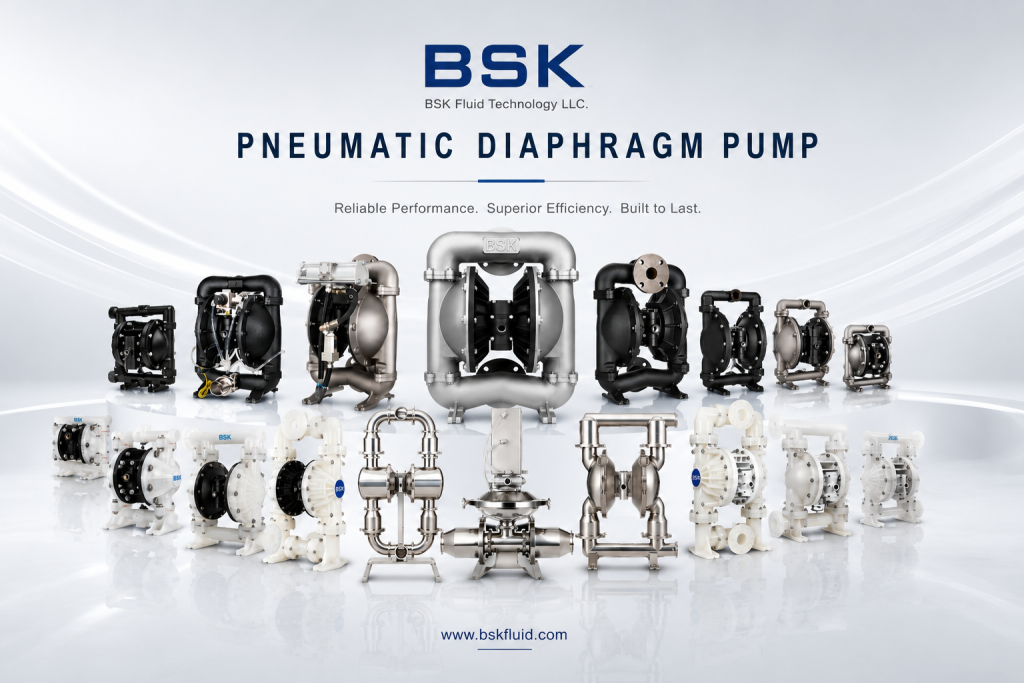
Looking for the right AODD pump for your application? BSK Fluid Technology offers a complete range of pneumatic diaphragm pumps in aluminum, stainless steel, cast iron, PP, and PVDF. With 30+ years of manufacturing expertise and patented ceramic air valve technology, we deliver reliable fluid transfer solutions worldwide.
Frequently Asked Questions
When should I choose PTFE vs Santoprene diaphragms?
Choose PTFE for strong acids, aggressive solvents, high-purity or temperatures above 80°C (shorter flex life, higher cost). Choose Santoprene for mildly corrosive/neutral fluids, longer diaphragm life (2-3x vs PTFE), food-grade use and cost efficiency.
Can BSK pumps handle food-grade and sanitary applications?
Yes. BSK sanitary AODD pumps feature a 316L body with electropolished finish (Ra ≤ 0.8 μm), tri-clamp connections for CIP, FDA-compliant diaphragms, and no dead legs for complete drainage. They are used in dairy, beverages, sauces, edible oils and chocolate transfer.
Are BSK pumps suitable for explosive / ATEX environments?
Yes. AODD pumps are powered by compressed air with no electricity, making them inherently safe for ATEX Zone 1/2 (gas) and Zone 21/22 (dust). For ATEX compliance use a conductive grounded metallic body or PTFE diaphragms with conductive additive for plastic bodies, and route the air exhaust to a safe area.
Why choose an AODD pump instead of a centrifugal pump?
AODD pumps excel with high-viscosity fluids (up to 10,000 cP), abrasive slurries and shear-sensitive liquids. They run dry without damage, are self-priming, handle solids up to 6mm, and are safe for explosive environments with no electricity. Centrifugal pumps suit very high flow (>1000 L/min) or high pressure (>10 bar).
Where can I get a quote for the right AODD pump for my application?
BSK Fluid Technology engineers provide a personalized pump selection within 24 hours. Share your fluid properties, flow rate and pressure requirements via the Contact page or WhatsApp +86-134-3105-8937, and we will recommend the optimal model from our aluminum, stainless steel, cast iron, PP and PVDF AODD range.


