
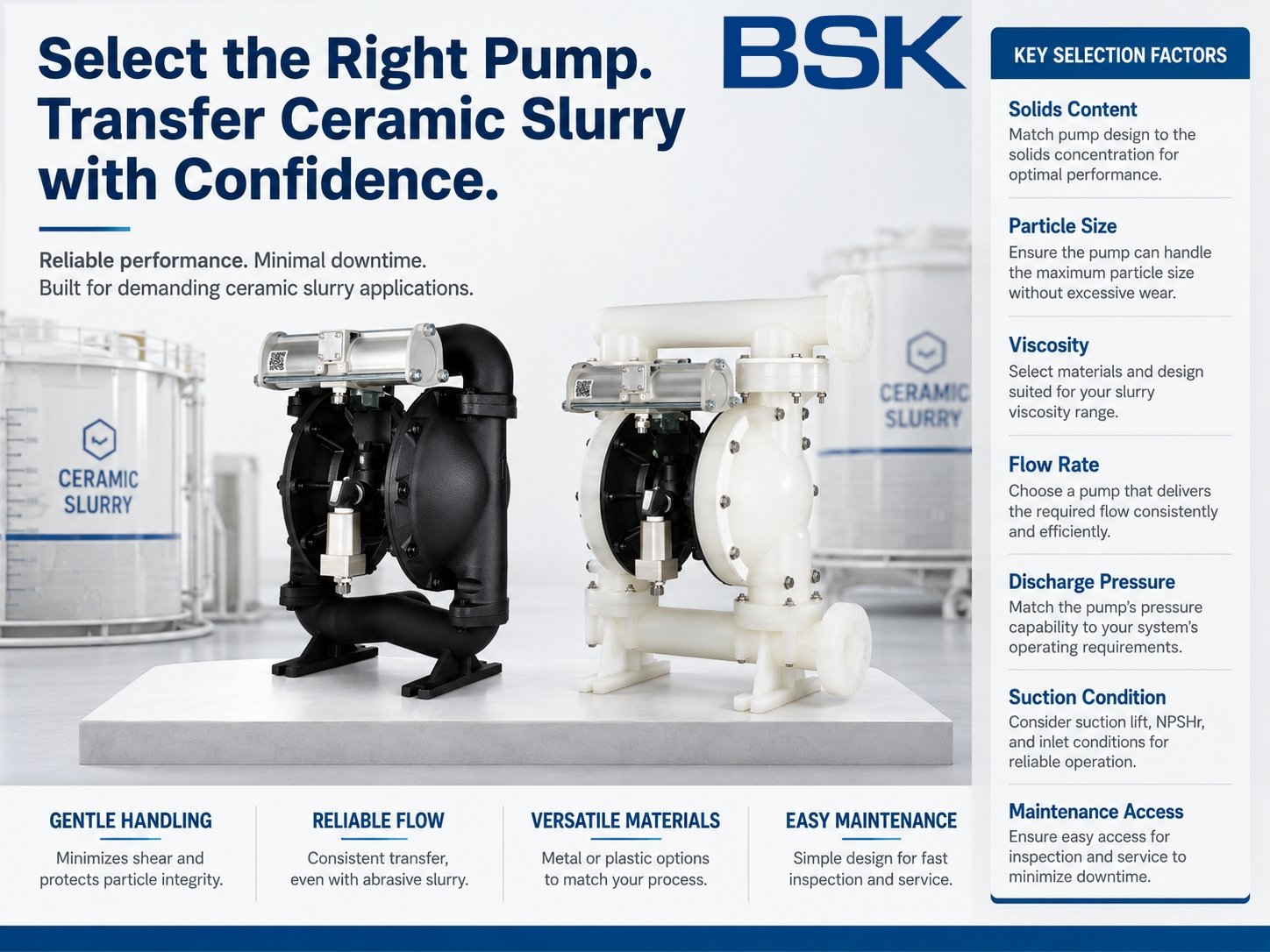
Pneumatic Diaphragm Pumps for Ceramic Slurry Transfer
Introduction
Ceramic slurry transfer is a demanding application for any industrial pump. The medium may contain clay, glaze, mineral powder, ceramic particles, pigments, additives, and water in different proportions. Even when the slurry looks pumpable in a tank, it can settle, thicken, abrade wetted parts, or block a poorly designed suction line. This is why buyers should treat ceramic slurry as an application-specific duty, not as a normal water-transfer task.
Where This Pump Is Commonly Used
In ceramic production, pneumatic diaphragm pumps may be used for glaze transfer, clay slurry movement, pigment or additive transfer, filter feed support, tank circulation, waste slurry transfer, and temporary material handling between containers or process steps. Some applications are short batch transfers. Others involve repeated start-stop operation during production.
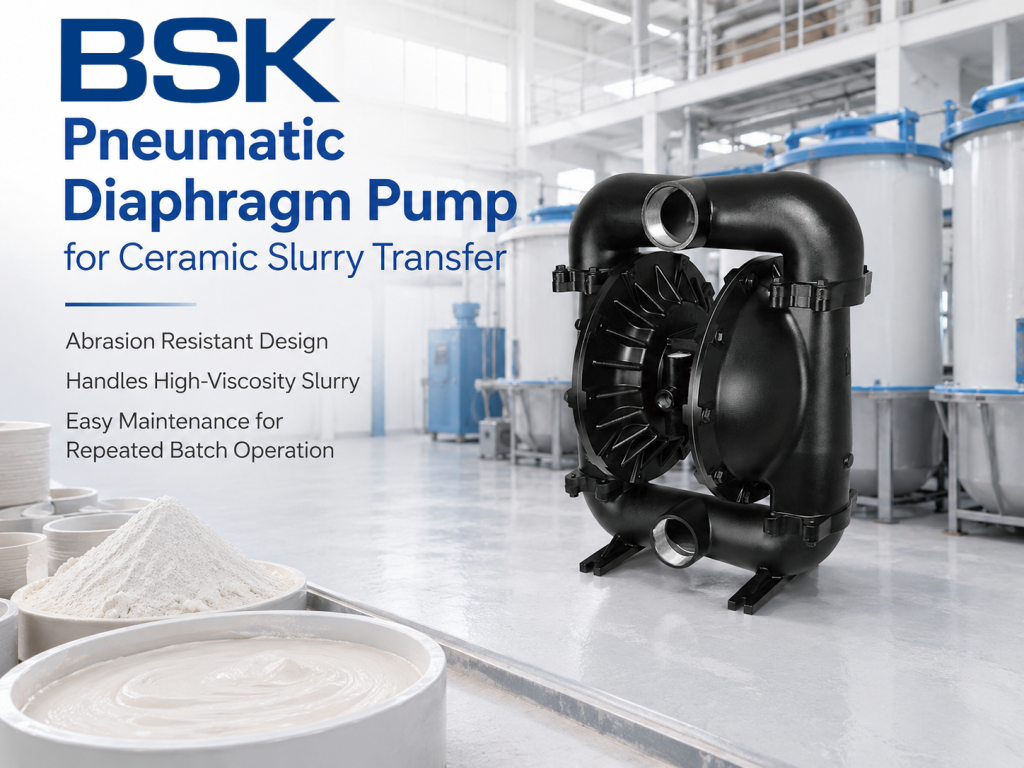
Typical Problems in Ceramic Slurry Transfer
The most common problem is abrasion. Ceramic slurry can contain hard mineral particles that gradually wear diaphragms, valve balls, valve seats, and pump chambers. The level of wear depends on particle hardness, concentration, flow velocity, cycling speed, and the selected materials.
A second problem is settling. If the slurry rests in a tank, hose, or pump chamber, solids may sink and create dense deposits. This can make startup difficult and may cause low flow or irregular cycling. For this reason, buyers should describe whether the slurry remains suspended or tends to settle quickly.
A third problem is viscosity. Some ceramic slurries become thicker after mixing, evaporation, or long holding time. Higher viscosity can reduce suction performance and may require a shorter suction line, larger piping, slower operation, or a different pump size.
A fourth problem is valve behavior. If the particles are large, heavy, or sticky, the check valves may not seat consistently. This can reduce flow or cause unstable operation. Valve material and configuration should be reviewed with the actual slurry, not chosen only from a general model list.
Key Pump Selection Factors
Before selecting a diaphragm pump for ceramic slurry, buyers should confirm the slurry composition, solid content, particle size, particle hardness, viscosity, temperature, required flow, required discharge pressure or head, suction condition, pipe size, pipe length, and operating pattern. It is also useful to explain whether the slurry is freshly mixed, recirculated, filtered, or taken from a settling area.
Solids data is especially important. A simple statement such as ceramic slurry is not enough. The pump supplier needs to know whether the particles are fine and uniform, coarse and abrasive, or mixed with agglomerates. The way the slurry settles in the tank also affects suction design and maintenance planning.
The installation should be reviewed as part of the selection. Long suction hoses, small-diameter piping, too many bends, or high discharge backpressure can create problems even when the pump body is suitable. For slurry transfer, keeping the suction side short and open is often more important than selecting a larger pump after the problem appears.
Material and Configuration Considerations
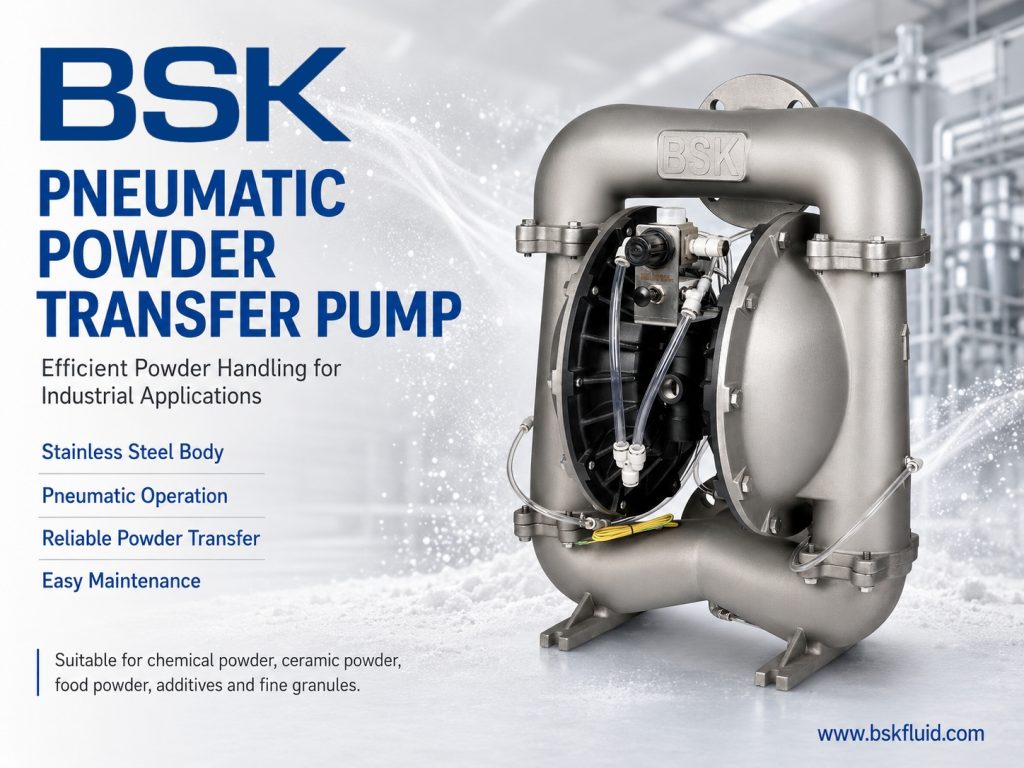
For ceramic slurry, material selection should focus on wear resistance, chemical compatibility, and service access. BSK product information includes pump body material options such as cast iron, stainless steel, aluminum alloy, and polypropylene. Cast-iron or metal pump configurations are often reviewed for abrasive industrial slurry duties, while other materials may be considered when corrosion or cleanliness requirements are more important.
Diaphragm, valve ball, valve seat, and seal materials should be checked together. BSK material references include options such as PTFE, Santoprene, NBR, FKM, PU, silicone, stainless steel, and ceramic in different product contexts. The right combination depends on the actual slurry, wear pattern, chemical additives, and operating conditions.
If the slurry contains abrasive solids, the pump should be selected with maintenance in mind. Buyers should ask how easily diaphragms, valve balls, and seats can be inspected and replaced. A configuration that is easy to service may reduce downtime in plants where slurry wear is expected.
AODD Pump vs Other Pump Types in This Application
Ceramic plants may also consider centrifugal pumps, screw pumps, hose pumps, or other positive-displacement pumps for slurry handling. A pneumatic diaphragm pump can be attractive when the process requires flexible transfer, intermittent operation, simple air-powered installation, and the ability to handle solids-laden fluids within the limits of the selected model.
Common Selection Mistakes
One mistake is choosing a pump only by inlet and outlet size. Port size does not confirm solids handling, abrasion resistance, suction performance, or internal material suitability.
Another mistake is ignoring settling behavior. If slurry deposits in the suction line or pump chamber, operators may experience difficult startup, low flow, or repeated cleaning. The installation should reduce dead zones and make flushing practical.
A third mistake is assuming that all slurries are similar. Glaze, clay slip, pigment slurry, wastewater sludge, and mineral slurry can behave very differently. The pump should be matched to the real medium and process point.
What Buyers Should Confirm Before Ordering
Before requesting a quotation, prepare a short application sheet. Include slurry name, composition, solid percentage if available, particle size, viscosity, temperature, required flow, discharge pressure or head, suction lift or flooded-suction condition, pipe size, pipe length, operating schedule, and cleaning method.
Also explain the slurry source and destination. Transferring from a well-mixed tank, a settling tank, a filter system, or a wastewater pit creates different pump duties. If the slurry can harden, dry, or form deposits after stopping, that information should be shared before model selection.
How BSK Can Support Your Selection
BSK Fluid Technology LLC. provides pneumatic diaphragm pump and material-selection support for industrial fluid handling. For ceramic slurry transfer, BSK can help review slurry properties, wetted-part materials, valve configuration, suction conditions, and maintenance requirements before recommending a suitable pump configuration.
Buyers can share the slurry composition, particle size, viscosity, solids behavior, flow requirement, pressure requirement, and installation layout with the BSK team. This makes the selection more reliable than choosing only by pump size or product appearance.
Conclusion
Selecting a diaphragm pump for ceramic slurry transfer requires attention to abrasion, settling, viscosity, solids behavior, piping, and maintenance access. A pneumatic diaphragm pump can be a useful solution in many ceramic production and slurry-transfer duties, but the configuration should be based on real working conditions.
If you are planning a ceramic slurry transfer project, contact BSK with your medium details and installation requirements. The BSK team can help review the application and discuss a practical pump configuration for your process.
Explore BSK Pneumatic Diaphragm Pumps
Looking for the right AODD pump for your application? BSK Fluid Technology offers a complete range of pneumatic diaphragm pumps in aluminum, stainless steel, cast iron, PP, and PVDF. With 30+ years of manufacturing expertise and patented ceramic air valve technology, we deliver reliable fluid transfer solutions worldwide.
Frequently Asked Questions
Why choose an AODD pump instead of a centrifugal pump?
AODD pumps excel with high-viscosity fluids (up to 10,000 cP), abrasive slurries and shear-sensitive liquids. They run dry without damage, are self-priming, handle solids up to 6mm, and are safe for explosive environments with no electricity. Centrifugal pumps suit very high flow (>1000 L/min) or high pressure (>10 bar).
What industries use AODD pumps?
AODD pumps are used in chemical processing, food & beverage (dairy, wine, CIP), painting & coating, ceramics & mining (slurries, glazes), pharmaceuticals, oil & gas, water treatment, electronics, automotive, and pulp & paper. Their ability to handle abrasives, solvents and shear-sensitive fluids makes them ideal across these sectors.
What pump body materials are available?
BSK offers five body materials: Aluminum alloy (general purpose, oils), Stainless steel 316 (corrosive chemicals, food, pharma), Cast iron (low-cost industrial, wastewater), Polypropylene/PP (acids, alkalis, lightweight), and PVDF (strong acids, solvents, high-purity).
When should I choose PTFE vs Santoprene diaphragms?
Choose PTFE for strong acids, aggressive solvents, high-purity or temperatures above 80°C (shorter flex life, higher cost). Choose Santoprene for mildly corrosive/neutral fluids, longer diaphragm life (2-3x vs PTFE), food-grade use and cost efficiency.
Where can I get a quote for the right AODD pump for my application?
BSK Fluid Technology engineers provide a personalized pump selection within 24 hours. Share your fluid properties, flow rate and pressure requirements via the Contact page or WhatsApp +86-134-3105-8937, and we will recommend the optimal model from our aluminum, stainless steel, cast iron, PP and PVDF AODD range.


